Caribbean Stud is a charmer. You learn it in one hand, there’s nobody to bluff, and a single dollar can theoretically win you a house. That’s the pitch, and it mostly holds up.
Here’s the part the felt won’t tell you. The ante carries a 5.22% house edge, steeper than basic strategy blackjack, baccarat, or even most of its stud-poker cousins. You can’t size your bet to your hand. It’s fold, or commit triple your ante, nothing in between. And the dealer fails to qualify about 44% of the time, which means you’ll hit a beautiful flush, raise with confidence, and watch the big bet limp to a push. It stings every time.
So who’s it for? Players who know poker rankings and want the calm of a game with no aggression, no opponents, and a jackpot meter glowing red in the middle of the table. If that’s you, and the meter’s high, pull up a chair. If you’re chasing the lowest edge in the pit, keep reading. We’ll point you somewhere cheaper.
Where it came from
The origin story is contested, which is half the fun. Poker theorist David Sklansky says he built the game in 1982 as “Casino Poker,” with the dealer showing two cards and no jackpot anywhere in sight. He couldn’t patent it. A player carried the concept to the King International Casino in Aruba (today’s Excelsior, which still bills itself as the birthplace), where the rules picked up their modern shape: one dealer up-card, the Ace-King qualifier. U.S. Patent No. 4,836,553 followed on June 6, 1989, in the names of James Suttle and Daniel Jones.
The patent wasn’t what made it spread. The progressive jackpot did. Caribbean Stud was among the first table games anywhere to bolt on a live progressive meter, pioneered through Mikohn Gaming, and that single change turned a Caribbean curiosity into a worldwide floor staple by the mid-90s. Sklansky, for his part, has said he never saw a dollar in royalties, a footnote that says a lot about how casino IP actually worked back then. The game later spawned Three Card Poker in 1994, essentially Caribbean Stud trimmed to three cards with a faster pace and lower minimums, which has since eaten much of its parent’s floor space.
The only decision that matters
Everything in Caribbean Stud comes down to one choice, and most players get it wrong by playing too many hands. Run yours through the trainer.
Editor's tool
Raise or fold? Run your hand
The same line a dealer-school instructor would teach. Answer two questions; we'll tell you the mathematically correct play.
Ace-King is the knife's edge. These three checks decide it.
Pick your hand to see the play.
The line is tighter than instinct suggests. You’ll fold close to 48% of the time under correct play, and that’s fine; those folds are the discipline keeping the edge from ballooning. Raise any pair or better without a second thought. Below Ace-King, let it go. The murky middle is Ace-King itself, and the refinement above settles it: a matching up-card, or a working Queen or Jack, tips you toward the raise. Raise every hand instead and you’ll donate roughly 1.3% on top of an already-pricey game.
The math nobody explains at the table
That 5.22% gets quoted everywhere, and it’s a little unfair to the game. It measures the edge against your ante alone. But you only raise about 52% of hands, so your average total wager works out near 2.045 units, and measured against everything you actually put at risk, the figure that matters (the “element of risk”) is 2.56%. Still not cheap. Just not the scare number on the strategy cards.
What does that cost in practice? At a $10 table running 60 hands an hour with clean play, you’re looking at roughly $31 an hour in expected loss. Add the dollar progressive on every hand and tack on another 30 to 60 cents an hour unless the meter’s enormous. Plan a session bankroll around 40 times your ante for an hour, 80 times for two — tighter discipline than you’d need at Let It Ride, where two of your three bets can be pulled back once the cards are out.
The $1 progressive: fantasy versus value
This is the bet everyone wants to make and almost nobody should, until the meter says otherwise. Type tonight’s number in.
Editor's tool
Is the $1 progressive worth it tonight?
Read the meter on the table, type it in. We'll check it against the ~$263,000 break-even point.
$
$0break-even ≈ $263k
Break-even figure per Wizard of Odds, standard Vegas pay table. A royal flush runs about 1 in 649,740 hands, so even a +EV meter carries enormous variance. This isn't a green light; it's context.
The break-even sits near $263,000. Under it, the dollar is a sucker bet, frequently worse than 25% to the house. Over it, the bet flips marginally positive, though “positive” is cold comfort when the royal that triggers it shows up about once every 649,740 hands. Wide-area progressives, linked across a state or country through the old Mikohn and later networks, are where the meter climbs into seven figures. It’s happened. The largest reported land-based hit topped $1.1 million at Atlantis in the Bahamas. The jackpot drop is also exactly why casinos keep dealing a game whose floor footprint has otherwise shrunk since 2010. The dollar adds up.
Payouts in a view
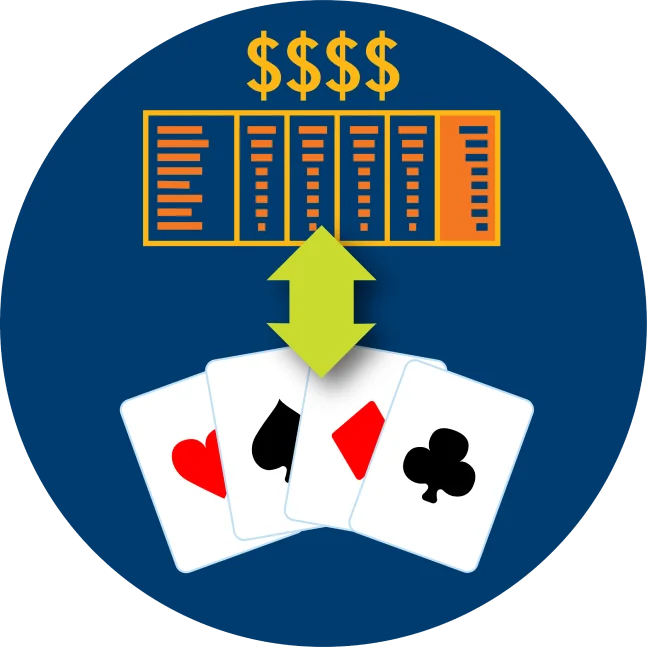
The Raise bonus pays on your hand strength once the dealer qualifies. Standard U.S. table:
Hand
Raise pays
Royal Flush
100:1
Straight Flush
50:1
Four of a Kind
20:1
Full House
7:1
Flush
5:1
Straight
4:1
Three of a Kind
3:1
Two Pair
2:1
One Pair / AK-high
1:1
The $1 progressive pays on its own, qualified or not. A royal takes the whole meter, a straight flush usually 10% of it, with fixed amounts below that ($500 for quads, around $100 for a full house, $50 for a flush, nothing lower). Always read the felt; European and online tables sometimes cap the bonus column.
Side bets beyond the progressive
The progressive isn’t the only extra on offer, and the rest range from mediocre to predatory. A common one is the 5+1 Bonus. It borrows the dealer’s up-card to build a six-card hand and pays on your best five, at a house edge somewhere around 8 to 15%. Proprietary bets badged Fuego, Power Play, Super Power and the like (Galaxy Gaming, Shuffle Master) run anywhere from 7% to 25%. None of them is a value play. They’re there for action, and they’re priced like it.
How it stacks up against the room
If you like the one-and-done stud format, you’ve got cheaper options sitting a few tables over. Measured by element of risk:
Game
Element of risk
Decisions
Progressive
Caribbean Stud Poker
~2.56%
1
Yes
Three Card Poker
~2.01%
1
Yes
Let It Ride
~2.85%
2
Yes
Mississippi Stud
~1.37%
3
Yes
Ultimate Texas Hold ‘Em
~0.53%
3
Yes
Caribbean Stud only beats Let It Ride on the numbers, and it’s plainly behind Mississippi Stud, with an element of risk near 1.4% across three raise-or-fold streets, and Ultimate Texas Hold ‘Em for anyone willing to learn a few more decisions. What it has that they mostly don’t is the jackpot, plus the unhurried, no-pressure rhythm that pulls people back.
A few table manners
Caribbean Stud enforces something most pit games don’t: your hand is yours alone. No showing your cards to a neighbor, no comparing notes, no table-talk strategy. Dealers will warn you and can pull you from the game for it. You touch the cards once. Pick up, look, decide, set them down behind your raise or push them forward to fold. No re-peeking. And the progressive chip has to be down before the deal; once the sensor lights, you’re locked in.
How we sourced this
The math here leans on the Wizard of Odds analysis of Caribbean Stud (house edge, element of risk, the ~$263,000 break-even, and the strategy line), cross-checked against the game’s documented history: U.S. Patent No. 4,836,553, the Wikipedia record of the Sklansky and Aruba origins, and official rule PDFs from the Massachusetts Gaming Commission, the Washington State Gambling Commission, and Loto-Québec. Availability and floor-trend notes come from current Las Vegas and Atlantic City listings. Where the meter math turns positive, we’ve flagged the variance rather than the upside, because the variance is what you’ll actually feel.